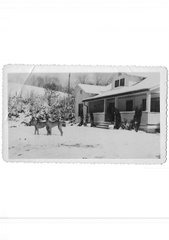
My great-aunt Thelma was a force to be reckoned with. Stout of heart and body, her corset pulled tight by long laces, she moved through the days of her life busy with the work of God and man. Her round face, usually smiling, was wreathed with long braids wrapped round her head. When she took her daily nap, we were awed to see her unlace her corset before she lay down and even more dumbfounded to watch her lace it back up again. Hugging Aunt Thelma was like hugging a tree. Above you there was warmth and softness, but where you reached to hug there was only a generous sized unyielding whalebone encased midsection.
She was always on her way somewhere or doing something and talking non-stop with her Virginia Tidewater brogue a treat to my ears. Her pickled peaches were a gourmet treat and a meal at her house was a pleasure. She and Uncle Bill, my granddaddy’s younger brother, lived in my great-grandparents house on the family farm. The front door had a doorbell that you “rang” by turning the handle which we children did ,often to the chagrin of the adults who would eventually tire of our fun and tell us to stop. Trees as old as time shaded the front yard and the side porch. In the library along with Aunt Thelma’s extensive collection of Reader’s Digest Condensed books, stood an antique square piano that I loved to play even though it was in sore need of repair and tuning.
Aunt Thelma and Uncle Bill never had any children so Bruington Baptist Church, our family church in Virginia, became her family and she was an ever present force in that community. Preachers came and went but Aunt Thelma remained. Sunday School teacher of the same children’s class for years, Women’s Missionary Union president, deacon without the name, she provided pastoral care for generations of church members whether they knew they needed it or not. Sitting on Grandma’s porch, we saw her car pass by on the road at the end of the lane at least three times a week on her way to church. When we saw her pass by, we knew we should leave soon or we would be late. During the years when my grandparents did not have a car, she would pull in and pick them up for church.
Her life surveyed and judged by today’s standards might seem limited and poor. They did not travel much past Richmond nor did they have much of what we deem important today. They had enough to be comfortable... enough food, much of it grown in their garden, shelter in the old family home, friends, a place in their community, church and work to do. Uncle Bill’s job as a mailman guaranteed them a salary in times when money was scarce. And yet her life was rich in many ways... rich in connection and community, full of family and friends, faithful to her church and her beliefs. She lies buried now in the old churchyard at Bruington Baptist, the last resting place for many of my mother’s family.
Lent, like Aunt Thelma laced up in her corset, is stiff and unyielding in its insistence upon our taking a long hard look at our hidden selves, the petty, mean and unattractive parts of ourselves that need a spring cleaning. Hugging Lent, like hugging Aunt Thelma, feels stiff and unnatural to souls that are emerging from winter’s darkness in need of warmth and light. But in the embrace of Lent, we find forgiveness as well as judgement, light as well as darkness and love as well as loathing. Paradox Mystery... lose your life to save it, he said. Look at all that you need to let go, lose it, and move on to the new life waiting for you around the corner. If you are faithful to the process, like Aunt Thelma at Bruington Baptist Church, a life rich in all that really matters is yours. Today I will search for and name the places and people to whom I wish to be faithful. I will list the ways I have failed and ask forgiveness for my mistakes and sins. And I will rest in the old, old promise that though my sins be as scarlet, they shall be as white as snow. Please, Lord?
Tuesday, March 9, 2010


Monday, March 8, 2010
Experience the Progression of the Experience
The following passage is the conclusion from Wendell Berry’s book “Life Is A Miracle”. I have been reading and re-reading this book for Lent and it has been a rich read. His education and writing skills have caused me to commit the sin of envy, fodder for my Lenten reflections. His words applied to my religious experience remind me how difficult it is to pass on what it is I know, what I have felt, what I have lived in my life with God. It is both judgement and hope for our future as children of God.
In speaking of the reductionism of modern science, we should not forget that the primary reductionism is in the assumption that human experience or human meaning can be adequately represented in any human language. This assumption is false.
To show what I mean, I will give the example that is most immediate to my mind:
My grandson, who is four years old, is now following his father and me over some of the same countryside that I followed my grandfather and father over. When his time comes, my grandson will choose as he must, but so far, all of us have been farmers. I know from my grandfather that when he was a child he too followed his father in this way, hearing and seeing, not knowing yet that the most essential part of his education had begun.
And so in this familiar spectacle of a small boy tagging along behind his father across the fields, we are a part of a long procession, five generations of which I have seen, issuing out of generations lost to memory, going back for all I know, across previous landscapes and the whole history of farming.
Modern humans tend to believe that whatever is known can be recorded in books or on tapes or computer discs and then learned again by those artificial means.
But it is increasingly plain to me that the meaning, the cultural significance, even the practical value, of this sort of family procession across a landscape can be known but not told. These things, though they have a public value, do not have a public meaning; they are too specific to a particular small place and its history. This is exactly the tragedy in the modern displacement of people and cultures.
My father, his father and his grandfathers before that were farmers in Georgia. My mother’s father and her grandfathers were farmers in Virginia. They each carry in their memories farming skills peculiar to their own geographical location at birth. Mother’s memories as she tagged along side her daddy, riding the plow horse as the fields were plowed, neighbors gathering to harvest the ice pond in the winter, the truck that came each week to the farm with fresh fish from the Chesapeake Bay, growing wheat to grind for your flour supply so bread could be baked... Her memories are so different from my daddy’s.
Daddy tended cows that were set free to roam the woods and fields each morning. It was his responsibility to gather them up in the evening. Growing tobacco, cotton and corn was hard work and all the children were field hands. Cornbread and biscuits, cane syrup, meat butchered in the backyard and smoked in the smokehouse, mules that provided the power needed to plow and harvest the crops... farming of a different sort from my mother’s experience.
I have heard these stories all my life and they are a treasure. And yet, hearing the stories does not teach me how to butcher a yearling, how to grow a healthy pasture, how to harvest ice, or how to plow with a horse or mule. Even growing up on my parent’s farm, I never lived what they lived, never felt the cycle of the seasons in quite the same way, felt the back breaking work necessary for survival, or had the same pleasures of swimming in the creek, watching the deer eat the windblows in the apple orchard in the early morning, eating the canned pork tenderloin that lives in my mother’s memory as one of the best tasting foods of her childhood.
And so it is with my faith experience. I can tell the stories of my mother growing up in the oldest Baptist church in Virginia, my growing up Baptist in a small country church in Georgia, being a part of a succession of Baptist churches all my adult life until my denomination self-destructed, leaving my faith home place and traveling to the strange land of a new denomination. These stories have a public meaning as Berry says but the private meaning, the particular meaning is impossible for me to capture in words alone.
Lent is a part of a faith experience that is public and particular at the same time. Its history is rooted in our beginnings with the meaning of many of its traditions lost in the telling of the stories. Knowledge captured in words written and spoken sheds a light on our path as we make this inward journey. Telling what we know, what we feel, what we have experienced is the only way we can hold on to the procession of the faithful through the centuries before us, all the grandfathers and grandmothers who walked before us on the Christian path to God.
Like the farmer in the parable of the barren fig tree, I have another year to dig and fertilize my soul during this particular season. So I practice Lent, walking in the fields of Christian experience, continuing my education, hearing and seeing and beginning to know some of what I need to know to be a competent Christian. And I write of this knowing words are a poor vehicle for the expression of my experience but it is the best I can do. And in the writing I become a part of “the living procession through time in a place that is the record by which such knowledge survives and is conveyed. When the procession ends, so does the knowledge.” May it never end.
Saturday, March 6, 2010
Lent... Public and Private
The memories of my early awakening to faith are still sharp and sweet. Raised in small country Baptist churches, I was taught by example, by sermons and teachers what being a Christian meant. At nine years of age, I told my parents I wanted to become a Christian and join the church. My daddy believed strongly in the Baptist principle of the age of accountability for children. He did not approve of childhood evangelism nor pressuring children to join the church. It was difficult for him to imagine that I was ready, that I understood what I was asking. So he required me to wait until I was twelve. The first Sunday after I turned twelve, I marched down the church aisle, shook Brother Kannon’s hand and made my first public profession of faith. Believers baptism, immersion for Baptists like us, and my first Lord’s Supper stand out in my faith memory scrapbook as clearly now as if it were yesterday. I had entered into the full fellowship of the larger church and was now deemed a member with all the rights and responsibilities attached to this privilege. Fifty four years later I am still a Christian, privately and publicly.
I’ve been intrigued with the results of a recent Pew Forum study on matters of faith and religion among the young, the millenial generation. Only 20% attend church but 75% believe in an afterlife. They feel alienated from religious institutions on both sides of the spectrum, liberal and conservative, that they view as too political. And one of the most interesting facts for me, the retention and growth rate for young people among evangelical churches outstrips mainline denominations. If I were a pastor or leader of a mainline denomination, I would be looking at the evangelical model and asking what they have that we don’t have.
I suspect the answers might be as simple as my experience in my little country church. I did not become a Christian because of a public stand taken by my pastor or church on an issue. I became a Christian because I was loved and taught the basics of the Christian faith by a family of faith that was committed to nurturing their young and witnessing their faith in language and life. The concept of a home church was very real for me as a child, teen, young adult and through the rest of my life. Faith was rooted in community and common belief. The personal experience of faith that flowers on the framework of our original source, the Bible, however one chooses to interpret it, seems to set the evangelical tradition apart from the more liberal expressions of Christian faith.
Much as I disagree with some of the traditional evangelical theology, I have experienced in my journey the power of the personal expressions of faith that are a hall mark of this tradition. Testimonies, verbal and lived out, charity at home and abroad, worship with feeling, a sense that one’s individual self matters to the Creator of All...I can understand how a generation raised on skepticism and computer screen realities would hunger for a skin faced experience of God. Most of us liberals are pretty wimpy and wishy washy about expressing our faith truths so no wonder our children are looking for someone who can and will speak from their hearts about a personal experience with God.
I teach a framing and matting class at our local community college. I am always amazed at how often conversation (without any help from me) turns to matters of faith. Thursday night our conversation centered on Lent and the practice of giving something up for Lent. In that room were conservative Christians who had never practiced Lent, liberal Christians who took Lent seriously, and some who were not affiliated with any faith system at all. It was fascinating and fun to hear folks speak what they believe(or not) with good humor and clarity. We have been gathering for eight weeks now every Thursday night so we know each others names, have grown to be a community centered on learning a skill, and in the process share much of our lives with one another. Sharing an essentially private experience, the practice of Lent, in a public setting led to a strengthening of those bonds.
Would to God our children can find that place, that community that will teach them, love them, be the Face of God in their lives whatever the denomination, whatever the politics of our secular nation, whatever the theology. I want my children’s children to have the sense of belonging to God, being a part of a church home where laughter and sorrow are shared, knowing others who live the life of a Christian, to be taught they are important and matter to the One who first loved us into being. I pray for each of them and for all the millenial generation that they will have a Clyattville Baptist Church in their lives, a church where they can be grown up in the faith. And as a part of my Lenten discipline, I will speak my private faith experience in public, sharing not only what I believe but also my joys and struggles and triumphs as a Christian.
Friday, March 5, 2010
Lent... Tough not rough
I stood in the check out line at Tractor Supply, my favorite store, with a load of horse, cow and chicken feed. The young woman checking me out heard me complaining about my rough hands. One of the side affects of farm work is calluses and rough skin on the side of my pointer fingers, split skin around my nails that bleed, and chapping during cold weather. She reached over and grabbed a tube of cream from a display next to the counter and handed it to me. “Try this”, she said. “It works for me and I tend horses and cows every day.” Holding her hands out for inspection, I could see they were a working woman’s hands but they were not split or rough. The calluses were smooth and not peeling. The cream was named “Tough not Rough... Intense Healing Cream”. Made in Aiken, South Carolina, it is a local product and I like using local products.
I have been using this cream every day now for a month and it lives up to her advertising. My hands are obviously the hands of a woman who works outdoors everyday but they are not bleeding, cracked and peeling. Every morning before I put on my gloves, I put on some cream. It sits by the back porch door so I won’t forget. Perhaps it is the regularity of application as well as the product itself... whatever... it works and I am grateful.
Lent is a little like my hand cream... tough not rough. It is forty days and nights of boot camp for the soul...giving something up to gain something. Friends of mine have given up various things for Lent. One has given up his glass of wine in the evening, a daily ritual that signals the end of the day and sets the tone for his evening. Another is consciously changing his life to simplify and live with only what really matters the most. Easier said than done. But this process of examination and repentance and letting go is absolutely necessary for anyone who takes Jesus seriously.
Doing without is not an easy sell in our current culture of easy come prosperity religion. Our culture reinforces this with buy now pay later plans. And, we are bombarded with images and words that promise beauty, health, wisdom, riches and happiness if we will just buy this or go there or eat this or do that. Giving up the illusion that acquiring something on the outside will change who we are on the inside may be the toughest thing of all to give up for Lent.
When we flee from the sight of our true selves, our souls stark naked in the harsh light of Lent, we give up our chance to see not only our sins and flaws, we miss the chance to see the unique miracle of creation that is contained in our being, the image of God that resides in our temple bodies here on earth. Those that have eyes to see, ears to hear and the stamina and will to persevere, see and hear and touch the face of God that lurks beneath the surface of us all. Its tough to hang in there for forty days but the journey is rich beyond measure.
Both Luke and Matthew record some words from Jesus that have become my Lenten motto. “ If anyone would come after me, let them deny themselves, take up their cross daily and follow me. For whoever would save their life will lose it; and whoever loses their life for my sake will save it. For what does it profit you if you gain the whole world and lose yourself?”
So, way to go, Malcolm! Have at it Hugh! Hip, hip, hooray for all who are staggering through Lent, marching like Marines at boot camp, giving up and gaining, hanging in there until the end of this tough season of faith. Our souls and our selves will be better for this time of penance and release. Hope I can keep up with you and not let the team down!
Subscribe to:
Posts (Atom)